In immersive role-playing games like ATLYSS, character progression is deeply tied to faction allegiances, moral creeds, and conflicting philosophies of governance. In the real world, human political beliefs are equally multifaceted—far too nuanced to fit into an oversimplified left-versus-right binary or a flat two-dimensional grid.
That is why the 12 Axes Quiz has gained widespread popularity among political typology enthusiasts and civic researchers. Accessible online at 12axesquiz.com, this modern assessment maps your political philosophy across twelve independent spectrums grouped into four foundational categories: Governmental, Diplomatic, Economic, and Societal.
Whether you want to discover which real-world nation mirrors your civic worldview, pinpoint your closest ideological philosophy, or simply navigate modern political discourse with greater clarity, this comprehensive guide explains how the 12 Axes Quiz works and what your scores truly mean.
What Is the 12 Axes Quiz?
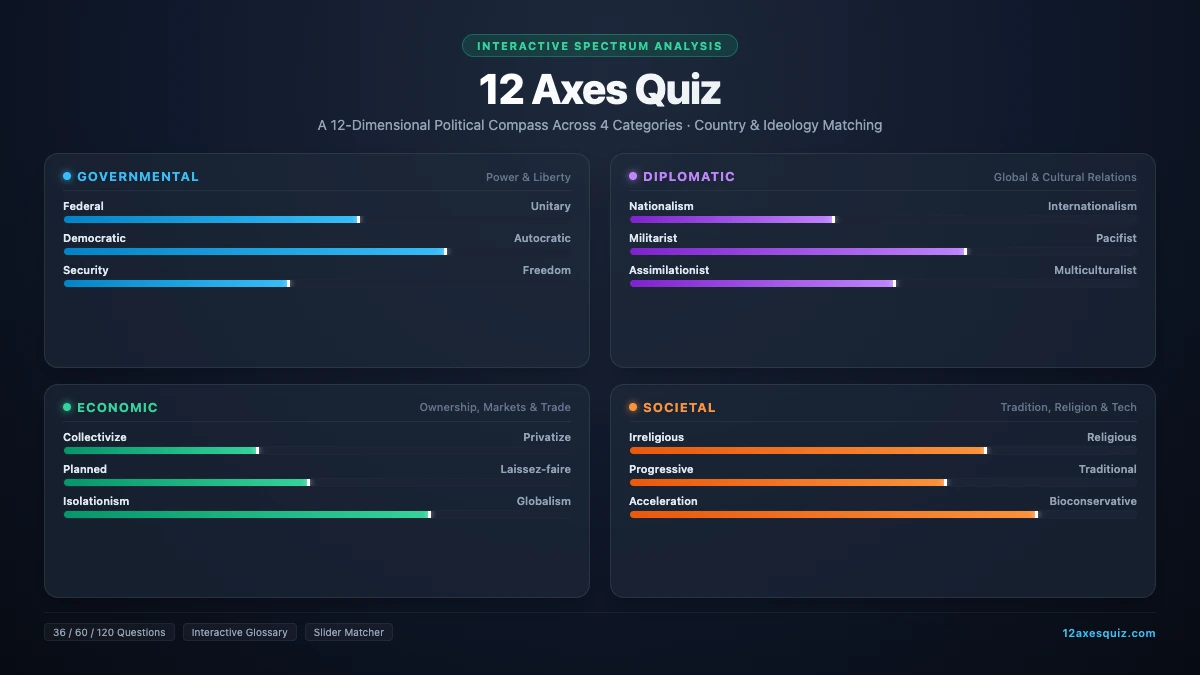
The 12 Axes Quiz is an advanced multidimensional political typology assessment. Drawing inspiration from earlier open-source political models such as 8values and 9axes, the modern 12 Axes Quiz refines and expands the evaluation matrix to deliver twelve distinct, calibrated spectrums.
Rather than assigning an arbitrary, one-word political label, the 12 Axes Quiz calculates a twelve-part numerical vector where each axis is scored from 0% to 100%:
- 0% represents complete alignment with the left pole of the axis.
- 100% represents complete alignment with the right pole.
- 50% represents a pragmatic, balanced, or moderate stance between the two positions.
On the independent platform 12axesquiz.com, this mathematical vector is subsequently compared against real-world governance profiles and political philosophies to identify your closest matching countries and ideological traditions.
The 12 Axes Explained Across 4 Core Categories
To ensure analytical clarity and conceptual rigor, the 12 Axes Quiz organizes its twelve spectrums into four foundational categories:
| Category | Axis ID | Left Pole (0%) | Right Pole (100%) | Core Question |
|---|---|---|---|---|
| Governmental | Federal vs Unitary | Federal | Unitary | Should regions govern themselves, or should a central authority rule? |
| Democratic vs Autocratic | Democratic | Autocratic | Should power stem from broad civic participation or strong leaders? | |
| Security vs Freedom | Security | Freedom | Does public order and safety outweigh individual civil liberty? | |
| Diplomatic | Nationalism vs Internationalism | Nationalism | Internationalism | Should policy prioritize sovereign self-interest or global cooperation? |
| Militarist vs Pacifist | Militarist | Pacifist | Is armed deterrence or diplomatic peacemaking the primary tool? | |
| Assimilationist vs Multiculturalist | Assimilationist | Multiculturalist | Should newcomers adopt mainstream culture or retain cultural traditions? | |
| Economic | Collectivize vs Privatize | Collectivize | Privatize | Should means of production be held collectively or privately? |
| Planned vs Laissez-faire | Planned | Laissez-faire | Should markets be state-managed or operate without intervention? | |
| Isolationism vs Globalism | Isolationism | Globalism | Should domestic industries be protected or open to free trade? | |
| Societal | Irreligious vs Religious | Irreligious | Religious | Should government stay secular or reflect religious principles? |
| Progressive vs Traditional | Progressive | Traditional | Should society embrace social reform or conserve cultural heritage? | |
| Acceleration vs Bioconservative | Acceleration | Bioconservative | Should technological augmentation and AI be accelerated or restrained? |
1. Governmental Category: Distribution and Limits of Power
The Governmental category in the 12 Axes Quiz analyzes how sovereign authority is structured, checked, and exercised. The fundamental balance between central authority and regional autonomy—classically explored by thinkers like Montesquieu and argued in the Federalist Papers—forms the conceptual cornerstone of these three axes:
- Federal vs Unitary (fu): The Federal pole champions the constitutional distribution of power to autonomous states, provinces, or cantons (as seen in Switzerland, Germany, and Canada). The Unitary pole maintains that ultimate authority must reside in a single supreme central government (exemplified by France, Japan, and Sweden).
- Democratic vs Autocratic (da): The Democratic pole demands universal suffrage, transparent public accountability, and institutional checks on power. The Autocratic pole values decisive executive leadership that can enact policy without legislative gridlock.
- Security vs Freedom (sf): The Security pole argues that public safety, crime prevention, and community order justify state surveillance and protective boundaries. The Freedom pole insists that civil liberties, habeas corpus, and personal privacy must remain sacrosanct.
2. Diplomatic Category: Foreign Relations and Cultural Coexistence
The Diplomatic category explores how a nation engages with foreign powers and demographic diversity:
- Nationalism vs Internationalism (ni): Nationalists prioritize domestic sovereignty, border security, and national identity above international commitments. Internationalists advocate for supranational bodies, international law, treaties, and cross-border cooperation.
- Militarist vs Pacifist (mp): Militarists view defense readiness, armed deterrence, and power projection as prerequisites for national survival. Pacifists consider armed conflict destructive and counterproductive, prioritizing diplomacy, mutual disarmament, and non-violent de-escalation.
- Assimilationist vs Multiculturalist (am): Assimilationists advocate for newcomers adopting the host society's language and civic norms. Multiculturalists champion cultural pluralism, arguing that diverse heritage communities enrich the broader social fabric.
3. Economic Category: Ownership, Market Control, and Trade
Economic beliefs in the 12 Axes Quiz are divided across three distinct dimensions:
- Collectivize vs Privatize (cp): This axis addresses the fundamental ownership of productive wealth. The Collectivist pole supports public infrastructure, co-operatives, and wealth redistribution. The Privatist pole defends private property rights, entrepreneurship, and individual capital accumulation.
- Planned vs Laissez-faire (pl): This axis examines market coordination. The Planned pole supports price regulations, state subsidies, and strategic economic directives. The Laissez-faire pole advocates for voluntary exchange, price discovery, and minimal state interference.
- Isolationism vs Globalism (ig): Isolationists endorse protective tariffs and localized supply chains to shield domestic workers. Globalists support open trade agreements, international commerce, and international supply chain integration.
4. Societal Category: Values, Religion, and Technology
The Societal category reflects the moral foundations, cultural values, and technological ethics that guide collective life:
- Irreligious vs Religious (ir): Irreligious viewpoints demand strict institutional separation of church and state, grounding governance purely in secular ethics. The Religious pole maintains that spiritual principles, religious heritage, and moral tradition should guide legal systems and public policy.
- Progressive vs Traditional (pt): Progressives champion continuous social reform, civil rights expansions, and questioning established customs. Traditionalists emphasize social stability, family continuity, and the preservation of historical customs.
- Acceleration vs Bioconservative (ab): A hallmark feature of the modern 12 Axes Quiz. The Acceleration pole supports rapid technological advancement, artificial intelligence, and transhumanist bio-enhancement to overcome human biological limitations. The Bioconservative pole advises ethical restraint, prioritizing the preservation of natural human biology and caution against unconstrained genetic or synthetic engineering.
Why the 12 Axes Quiz Outperforms the 2D Political Compass
For decades, the classic Political Compass positioned voters on a simple two-axis Cartesian plane: economic left/right on the horizontal axis and authoritarian/libertarian on the vertical axis. While groundbreaking in its era, this model creates critical blind spots:
- Conflating Social Reform and Economic Policy: On a 2D compass, cultural progressives and economic socialists are frequently lumped together in the same quadrant. This ignores free-market libertarians who champion social equality, as well as economic leftists with conservative social views.
- Ignoring Trade Policy Nuances: A free-market advocate who supports domestic manufacturing tariffs cannot be mapped coherently on a 2D grid. The 12 Axes Quiz cleanly isolates trade policy (Isolationism vs Globalism) from domestic property relations (Collectivize vs Privatize).
- Addressing 21st-Century Technological Ethics: Modern controversies surrounding artificial intelligence, human gene editing, and automation have no representation in legacy tests. The Acceleration vs Bioconservative axis bridges this gap.
- Distinguishing Decentralization from Authoritarianism: A government can be deeply democratic yet constitutionally unitary (like Denmark or New Zealand). The 12 Axes Quiz evaluates territorial organization (Federal vs Unitary) separately from governance mode (Democratic vs Autocratic).
Key Features of the 12 Axes Quiz Platform
On 12axesquiz.com, the assessment engine incorporates several features tailored to optimize user experience and analytical precision:
Three Flexible Test Lengths (36, 60, and 120 Questions)
To accommodate different needs, the platform provides three tiered options:
- Quick Mode (36 Questions): Features 3 curated statements per axis. Completed in under 4 minutes, providing an accessible initial overview.
- Standard Mode (60 Questions): Features 5 questions per axis. The ideal balance between completion time and measurement fidelity.
- Full Mode (120 Questions): Features 10 detailed questions per axis, exploring complex policy nuances for an exhaustive ideological profile.
Built-in Interactive Political Term Glossary
A common barrier in political surveys is technical jargon. During the test on 12axesquiz.com, complex terms—such as universal basic income (UBI), protectionism, transhumanism, theocracy, secession, and universal suffrage—include interactive tooltips. Tapping any underlined term surfaces an objective, concise definition directly in the interface without interrupting quiz progress.
Real-World Country and Ideology Profile Matching
Once your twelve scores are calculated, the algorithm benchmarks your coordinates against dozens of sovereign states and established political traditions. The platform calculates mathematical proximity using Euclidean distance vectors, revealing which nation's political structure most closely reflects your convictions—whether that is the federal direct democracy of Switzerland, the Nordic model of Norway, or the competitive market economy of Australia.
Direct 12-Axis Slider Matcher
For users who have previously taken a 12-axis evaluation or the original 12 axes vercel app, answering all 120 questions again is unnecessary. The interactive slider matching tool on 12axesquiz.com allows you to manually adjust your twelve percentage values and instantly generate matching country and ideology profiles.
Privacy-Preserving Client-Side Architecture
Unlike commercial personality quiz portals that collect personal data or require account creation, the 12 Axes Quiz operates entirely in your local web browser. No responses are stored on backend databases, and your results are encoded into a lightweight, shareable URL parameter.
How to Take the 12 Axes Quiz for Maximum Accuracy
To ensure your results authentically represent your political principles, keep these recommendations in mind:
- Vote on Principles Rather Than Current Personalities: Frame your answers around how human society ought to function in principle, rather than reacting to specific political figures or current news cycles.
- Use the Neutral Option Judiciously: The "Neutral / Unsure" button is helpful when you are genuinely undecided, but overusing it pulls your scores toward the 50% midpoint and dilutes matching accuracy.
- Separate Moral Vision from Practical Obstacles: If you believe an initiative is morally and socially desirable, answer in favor even if contemporary implementation faces logistical hurdles.
Frequently Asked Questions About the 12 Axes Quiz
What is the 12 Axes Quiz?
The 12 Axes Quiz is an interactive political typology assessment that measures personal viewpoints across twelve independent spectrums encompassing governmental, diplomatic, economic, and societal topics.
How long does the 12 Axes Quiz take to finish?
Quick Mode takes approximately 3 to 4 minutes. Standard Mode takes 6 to 8 minutes, and Full Mode takes 12 to 15 minutes.
What does a score of 50% mean on an axis?
A 50% score indicates a balanced, centrist, or pragmatic position that does not strongly favor either extreme pole of that spectrum.
Is the assessment free and private?
Yes. The 12 Axes Quiz is free, open to all users without registration, and processes all calculations directly in your browser.
Conclusion: Discover Your Ideological Profile
Understanding where you stand in the civic landscape requires an assessment framework that honors philosophical complexity rather than stripping it away. By examining twelve distinct dimensions across state authority, foreign affairs, economic organization, and cultural values, the 12 Axes Quiz offers clarity into your political identity.
Ready to see where your principles align? Head over to 12axesquiz.com to take the 12 Axes Quiz, explore your twelve-dimensional profile, and discover your closest country and ideological matches today. For more gaming guides, lore overviews, and system breakdowns, explore our latest articles on the ATLYSS Journal.
References
- 12axesquiz.com Official Political Spectrum Test12axesquiz.com
- Montesquieu & Separation of Powers · Stanford Encyclopedia of Philosophyplato.stanford.edu/entries/montesquieu
- Federalist No. 10 & 51 · The Avalon Project at Yale Law Schoolavalon.law.yale.edu/18th_century/fed10.asp
- 8values Multi-Axis Political Typology · GitHubgithub.com/8values/8values.github.io